Restorative Yoga: The Practice of Leaving the Race
We think we know how to rest.
We sit on the couch. We scroll. We watch television while answering texts. We take a day off and fill it with errands, laundry, appointments, and all the things we haven’t gotten to yet. Our bodies may have stopped moving, but our minds are still running.
Restorative yoga offers us a different kind of rest. It is a quiet, deeply supported practice that asks us to step out of the constant current of doing. Not to accomplish something. Not to stretch farther. Not to push through. Simply to pause long enough to notice what happens when the body no longer has to hold everything up.
And that can be much harder than it sounds.
What Is Restorative Yoga?
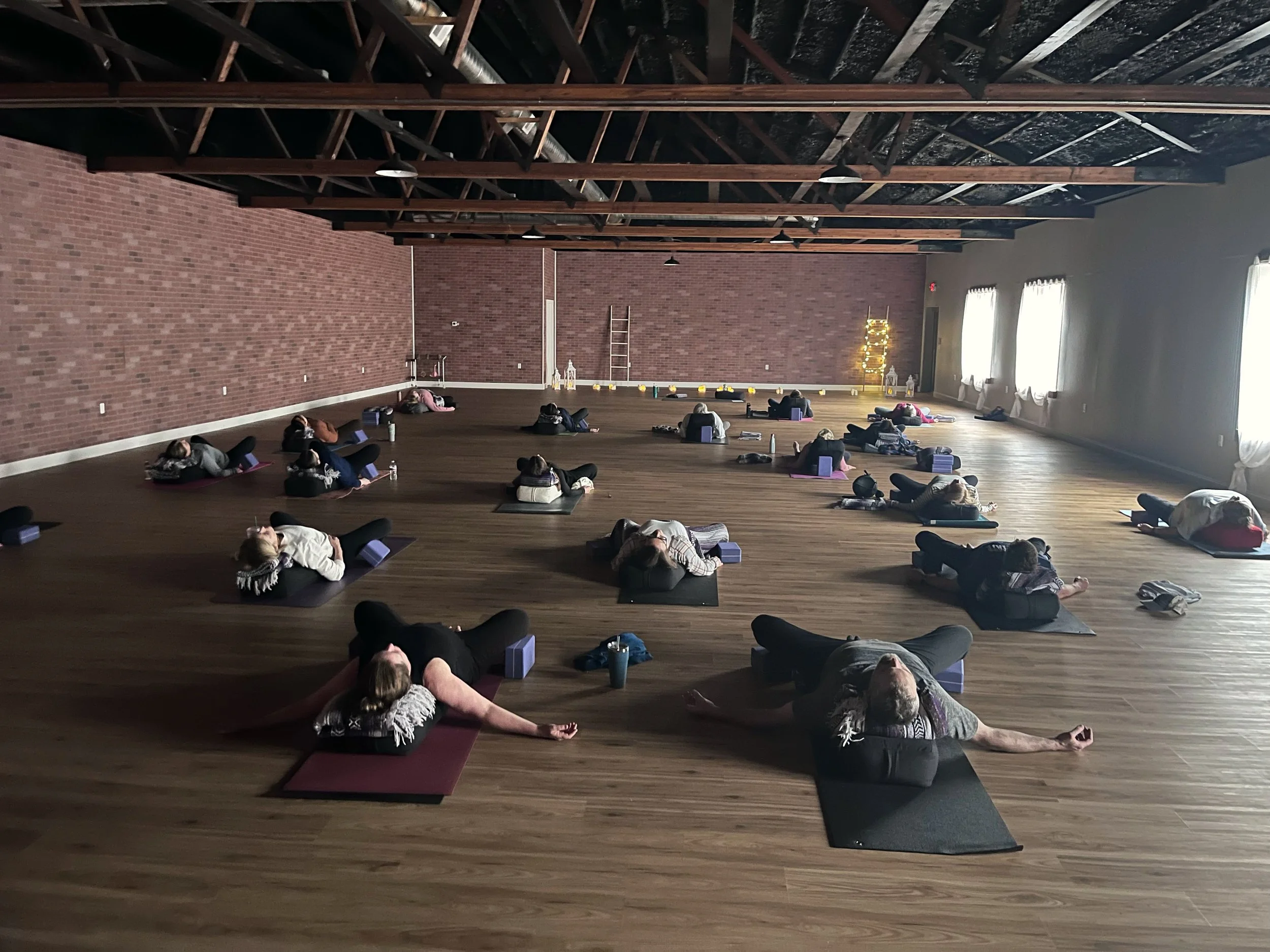
In restorative yoga, the body is placed in comfortable, fully supported shapes using bolsters, blankets, blocks, straps, and other props. Each posture is held for a longer period of time so the body has an opportunity to settle.
The goal is not to chase sensation or create the deepest stretch possible. It is to arrange the props so the body does not have to work to maintain the shape.
Restorative yoga may look like lying down and physically, that is sometimes exactly what we are doing. But the practice is not passive in the way we often think of passivity. It asks for our presence.
It asks us to stay.
Why Stillness Can Feel So Difficult
Stillness is the antithesis of so much of our day-to-day lives. We move from one task to another. We answer the notification. We make the list. We solve the problem. We care for everyone. Even the activities we call relaxing can keep our attention stimulated and our nervous systems engaged. Then we come into a restorative pose and suddenly there is nowhere else we need to be. That is often when the resistance arrives.
We fidget. We adjust the blanket again. We wonder how much time has passed. We remember something we forgot to do. We may feel impatient, restless, emotional, or convinced that we are somehow doing the pose incorrectly. None of this means we are bad at restorative yoga. It means we are meeting the practice.
Restorative yoga gives us a place to notice our habits without immediately acting on them. With time, support, and breath, we may begin to soften some of the effort and bracing we carry—the things I sometimes call the “issues in our tissues.”
The purpose isn’t to force those layers away. It is to create enough support that we no longer have to grip them quite so tightly.
What Does the Science Say?
Yoga research is encouraging, but it is important to speak about it honestly. Research on yoga more broadly suggests that regular practice may support stress management, mental and emotional well-being, and sleep. Studies devoted specifically to restorative yoga are fewer and generally smaller, although early findings suggest that the practice may be helpful for relaxation and perceived stress.
What we cannot responsibly promise is that one class will cure anxiety, fix insomnia, heal digestive problems, or “reset” the nervous system. Restorative yoga is not a replacement for medical or mental-health care.
What it can offer is a structured opportunity to slow down, breathe, become aware of the body, and practice being still in a supportive environment. Those are meaningful things, even without turning them into a miracle claim. Sometimes the benefit is much simpler: for 75 minutes, you are not being asked to produce, perform, improve, or take care of anyone else. You are allowed to be supported.
“I Didn’t Lose the Race. I Left the Race.”
There is a story I often share in my restorative classes about a cyclist who had prepared for a race with incredible intensity.He trained relentlessly. He refined every detail. He removed anything that might slow him down. When race day arrived, all that work appeared to be paying off: he was in the lead.
Then a heron flew across his path. Something about the grace and beauty of the bird stopped him. He put his feet down and watched as the other cyclists sped past. He did not win the race.
Years later, when people asked why he had lost, his answer was always the same: “I didn’t lose the race. I left the race.”
I love that story because so many of us never give ourselves permission to leave the race.
We keep going because everyone around us is going. We measure our worth by how much we finish, how much we carry, and how well we keep pace. Like ants marching, we move from one thing to the next without always asking whether we still want to be in the race at all.
Restorative yoga gives us practice putting our feet down. It invites us to notice the heron.
A Practice of Being, Not Doing
I have loved and taught restorative yoga at Jaya Yoga Studio for many years. For roughly 14 years, I have also incorporated Young Living essential oils into these practices. Aroma becomes part of the sensory experience, a familiar cue that it is time to arrive, settle, and turn inward. But the heart of the practice is not the props, the poses, or the oils.
It is permission.
Permission to stop striving.
Permission to receive support.
Permission to encounter resistance without judging it.
Permission to be a human being instead of a human doing.
Restorative yoga does not ask you to earn your rest. It reminds you that rest was never something you had to earn in the first place.
If you’d like to explore restorative yoga with us, view our class schedule to find an upcoming offering at Jaya Yoga Studio in Clarks Summit.